
Mantra of the day
Welcome to your daily practice
ॐ
Guhya
Verse of the day
—
Sacred utterances
Mantras & Hymns
The Vedic and Upanishadic invocations — from the śānti pāṭhas of the Upaniṣads to the great Vedic mantras of light, protection, and peace.
Viṣṇu Sahasranāma
The thousand names of Viṣṇu — dhyāna, the 108 ślokas, and the phalaśruti.
Śrīmad Bhagavad Gītā
The Song of the Lord
Eighteen chapters, seven hundred verses — the dialogue of Kṛṣṇa and Arjuna on the battlefield of Kurukṣetra. Each verse here in Sanskrit, transliteration, and English.
English translation by Swāmī Śivānanda (Divine Life Society, 1942/1969), distributed freely for non-commercial use by the DLS. Public domain in India since 2023; copyright still applies in some jurisdictions. Source.
Verses one returns to
Key Verses of the Gītā
The verses one returns to — the eternity of the Self, the cardinal teaching of karma-yoga, the sthita-prajña, action-in-inaction, the equal vision, the cosmic vision, and the carama-śloka. Advaita-primary, with Vaiṣṇava comparison notes where the schools genuinely diverge.
Pāṭhas of peace
Śānti Mantras
The peace invocations of the Vedas — chanted at the opening and closing of every reading. May all beings be happy. May all beings be free.
Sittings beside the teacher
The Ten Principal Upaniṣads
The crown of the Vedic tradition — dialogues between teacher and student on the nature of the Self, brahman, and liberation. Devanāgarī, IAST, and English meaning for every verse.
English translations original to this app, rendered literally and line-aligned to the Sanskrit. Verification against a printed scholarly edition is recommended before academic use.
Verses one returns to
Key Verses
The four mahāvākyas, the great parables, and the foundational definitions — gathered as a corpus. Each verse remains in its line-aligned form; tap to read in context.
Guhya Academy · The four questions
Key Verses
A curated reader. The lines one returns to — from the Gītā, the Upaniṣads, and the Yoga Sūtras — organised by the four questions the tradition cannot leave alone.
Guhya Academy · Two taxonomies
Vices and Virtues
The Lord's catalogue in Gītā 16, and Patañjali's eight-limb discipline. Description first; prescription second.
Patañjali • Pāda
The Yoga Sūtras
Patañjali’s 195 aphorisms in four pādas — the foundational text of classical yoga. “Yogaḥ cittavṛtti-nirodhaḥ.”
English meanings from Rāma Prasāda (1912), public domain. Devanāgarī and IAST from sanskrit-trikashaivism.com.
The thousand names of Viṣṇu
Viṣṇu Sahasranāma
From the Anuśāsana Parva of the Mahābhārata — Bhīṣma’s recital to Yudhiṣṭhira on the bed of arrows. Seven dhyāna verses, 108 stotra ślokas, 28 phalaśruti.
English meanings: literal etymological glosses of each Sanskrit name, original to this app. Devanāgarī and IAST sourced from sanskritdocuments.org.
Hymns of devotion
Stotras
Devotional hymns composed by the great seers — Śaṅkarācārya and others. Sung as offering, refuge, and the kindling of bhakti.
The deeper world
Enter the Teaching
The sacred texts, the foundational concepts, and a Pāṇinian Sanskrit curriculum — one place to enter the tradition.
Translator's Preface
On approach, grammatical gender in Sanskrit, the women the tradition did not lose, and what fidelity to a sacred text actually demands.
Preface
Sacred Texts & Teachings
Bhagavad Gītā
The Song of the Lord — Kṛṣṇa's teaching to Arjuna on the field of Kurukṣetra. All 700 verses, Devanāgarī, transliteration, and English. The text complete.
ItihāsaUpaniṣads
The forest teachings — Bṛhadāraṇyaka, Chāndogya, Māṇḍūkya and the rest. The source of all Vedānta. Mahāvākyas annotated with Śaṅkara's commentary.
ŚrutiYoga Sūtras
Patañjali's 195 sūtras — the complete science of yoga as liberation. The aṣṭāṅga, the kleśas, samādhi, kaivalya.
DarśanaViṣṇu Sahasranāma
The thousand names of Viṣṇu from the Anuśāsana Parva of the Mahābhārata. Seven dhyāna verses, 108 stotra ślokas, and the phalaśruti — with literal etymological glosses.
StotraYoga Vāsiṣṭha
The teaching of Vasiṣṭha to Rāma. The most expansive Advaita text — consciousness, creation, and liberation told as story.
VedāntaKey Verses
The Guhya reader — twenty anchor verses across the Gītā, the Upaniṣads, and the Yoga Sūtras, organised by the four questions. Devanāgarī, IAST, English, and a brief Advaita gloss.
Curated
Deeper Concepts
Tattvas
The twenty-five principles of Sāṃkhya — the mapping of consciousness into manifestation, from puruṣa to the five gross elements.
SāṃkhyaVedic Cosmology
The four yugas, Kali Yuga's paradox, the Brahmāṇḍa. Time, creation, and the arc of dharma across vast cycles.
CosmologyNava-Dvāra
The city of nine gates — the subtle body, the prāṇas, and the inner architecture of the human being as described in the Upaniṣads.
Subtle BodyKṣetrajña
The knower of the field — Gītā chapter XIII as philosophy. Prakṛti and puruṣa, the field and its witness.
AdvaitaKālī
The Dark Mother — time, iconography, the Mahāvidyās, the bīja Krīṃ, and the Tāntrik philosophy of liberation through darkness.
Śakti TantraGuhya
The intimate teaching. In the Bhagavad Gītā, Kṛṣṇa names his own instruction guhyatamam — most intimate. Not concealed from the world; entrusted only to the prepared ear. The four mahāvākyas open here.
GuhyatamamGuhya Academy
The curated curriculum — Foundations, Pāṇinian Sanskrit, the deeper tāntrik teachings. A living body of work that grows pass by pass. Supported on Patreon; the home of guhya.academy.
Join →
Foundational Concepts
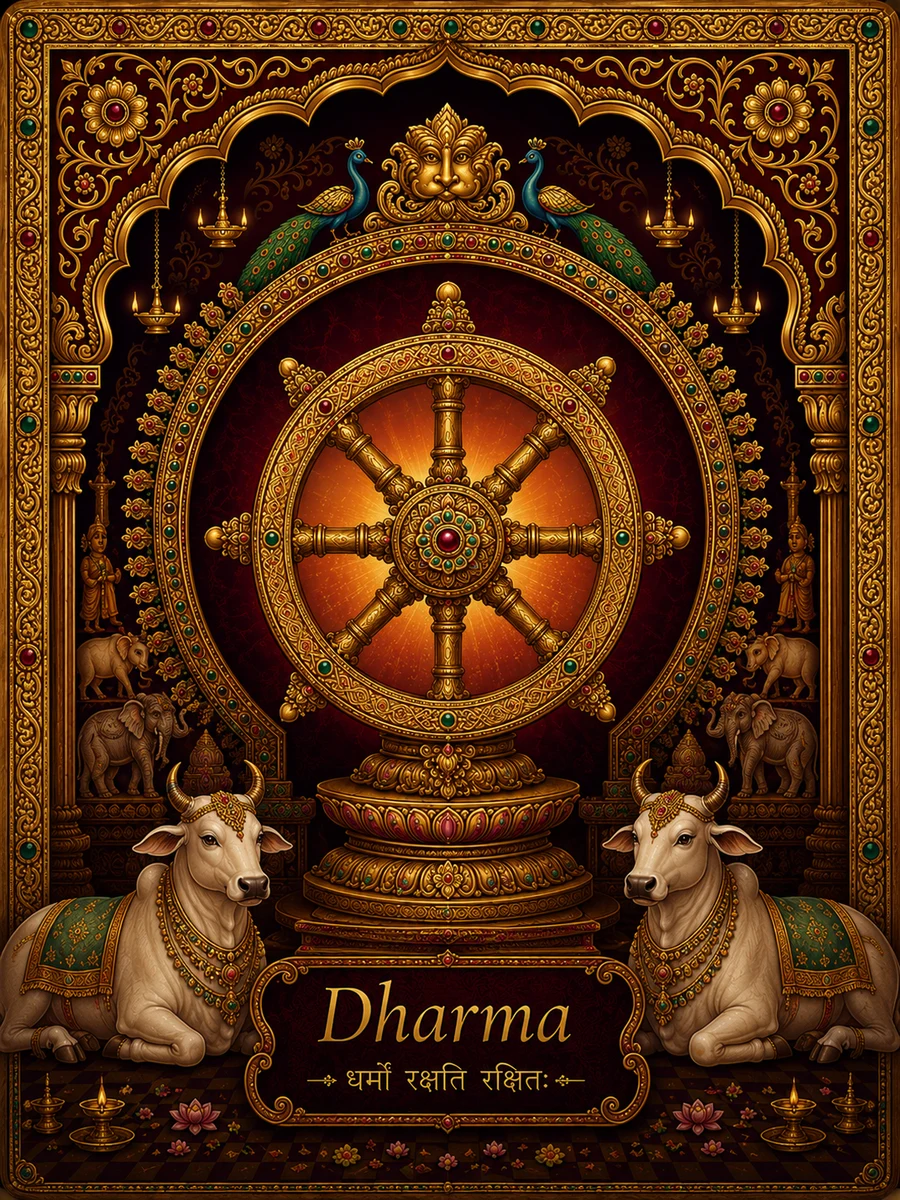
Dharma
The law woven into the nature of things — not rules imposed from outside but the structure that holds everything in proper relation.
Foundation
Saṃsāra
The turning wheel — the ceaseless movement of experience driven by desire. Beautiful, alluring, and built on a fundamental misreading of what is real.
Foundation
Saṃskāra
The impressions left by every experience — grooves worn into the mind that shape perception, reaction, and what we call character.
Foundation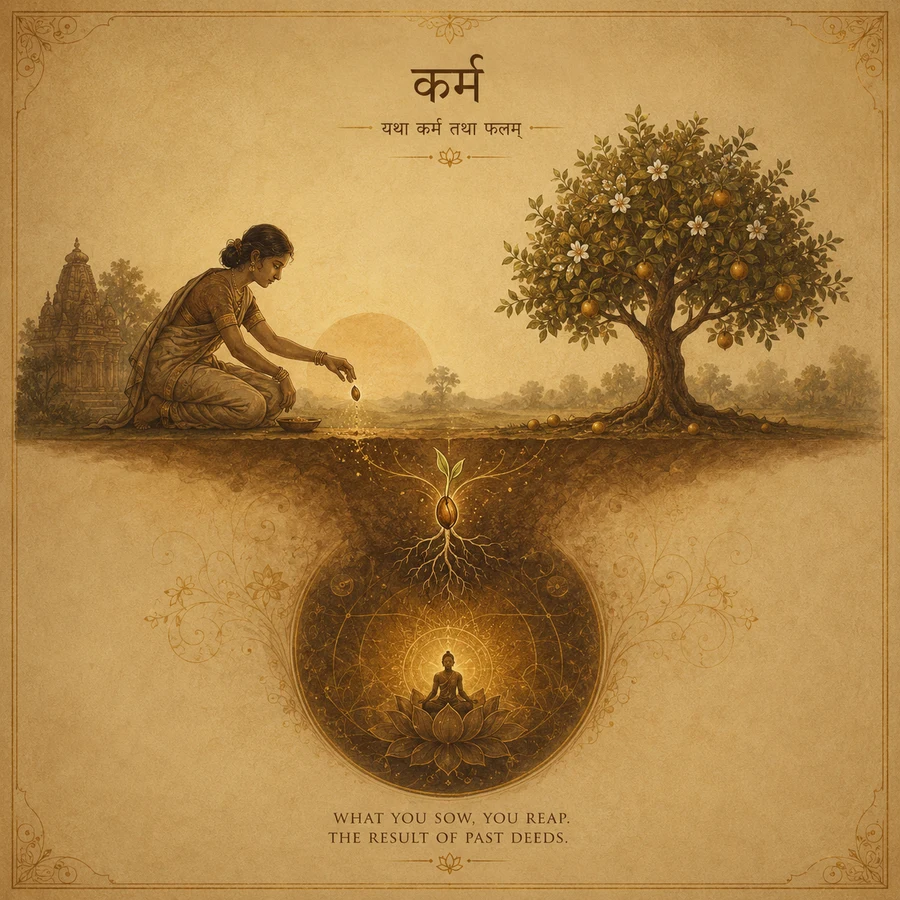
Karma
Action and its residue. Not punishment and reward but physics — every act leaves a trace that shapes what comes next, across this life and beyond.
Foundation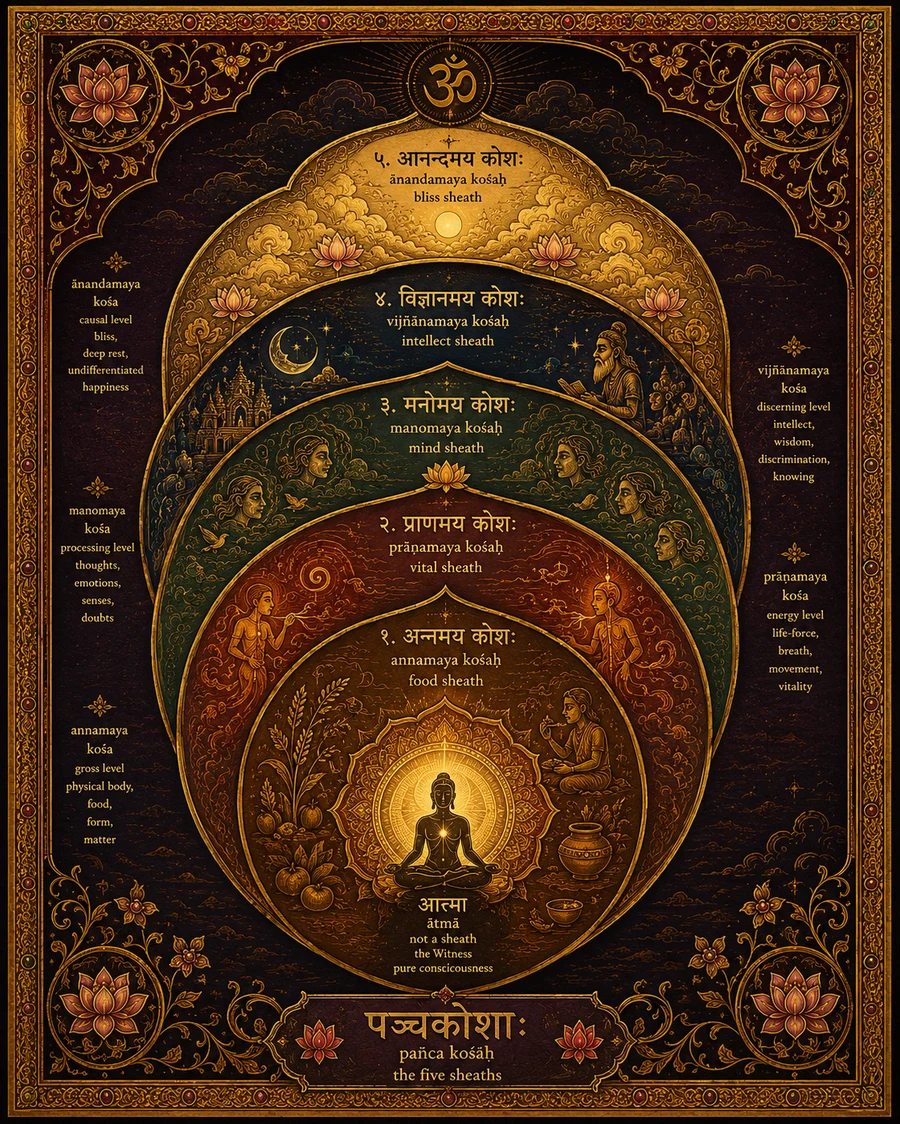
The Five Kośas
The sheaths of the self — from gross body to bliss sheath. A Upaniṣadic map of what you are beneath the role you play.
FoundationAdvaita
Not-two. The teaching that the seer, the seen, and the seeing are not three things but one undivided awareness wearing the appearance of difference.
FoundationPañca-kleśa
The five afflictions of Yoga Sūtras II.3 — ignorance, ego, attachment, aversion, clinging to life. The structural causes of suffering, named precisely.
FoundationCakras & Kuṇḍalinī
The seven energy centres along the suṣumnā — mūlādhāra to sahasrāra — and the coiled current that rises through them. The Tantric map of the subtle body.
FoundationAvasthā-traya
The three states — waking, dream, deep sleep — and the fourth that is no state at all. The Māṇḍūkya Upaniṣad's twelve-verse map of consciousness.
FoundationMantra-śāstra
The anatomy of mantra — bīja, devatā, ṛṣi, chandas, viniyoga. Why sound, recited with attention, is treated as a body of consciousness.
FoundationThe Three Guṇas
Sattva, rajas, and tamas — the three strands woven through everything in prakṛti. Not vices and virtues but the basic textures of matter, mind, and mood.
FoundationMokṣapaṭam
Snakes and ladders — the original karma board. A teaching game from medieval India where each square is a virtue, a vice, or a stage of liberation.
FoundationVices and Virtues
Daivī sampad and āsurī sampad — the two human inheritances of the Gītā's sixteenth chapter, paired with the yamas and niyamas of classical yoga. The textures of the ethical life.
Foundation
Sanskrit — A Pāṇinian Curriculum
Varṇamālā
The sounds of Sanskrit arranged by place and manner of articulation — vowels, consonants, and the logic of the Devanāgarī script.
ScriptSandhi — Grammar
Vowel sandhi, consonant sandhi, visarga sandhi — and how to reverse them when reading. The four junction patterns with exercises.
PhonologySubanta
The declined noun — liṅga, vacana, vibhakti. The rāma and phala paradigms; consonant stems. 21 forms from a single root.
NominalsTiṅanta
The conjugated verb — dhātu and gaṇa, the laṭ paradigm, the four lakāras. Every present-tense verb form from bhū, gam, kṛ.
VerbalsSamāsa
Sanskrit compounding — tatpuruṣa, bahuvrīhi, dvandva, avyayībhāva. How to build and decode the long compounds of sacred texts.
CompoundsPāṭha — Reading
Reading three key verses word-for-word: Gītā I.1, Īśa Upaniṣad 1, Yoga Sūtras I.2 — with full sandhi and grammatical analysis.
TextsKāraka
The six syntactic roles that Pāṇini defines by function, not form — agent, object, instrument, recipient, source, locus. With voice.
SyntaxKṛdanta
Participles, gerunds, infinitives — words built directly from verbal roots. -kta, -śatṛ, -tumun, -ktvā, and how they chain Sanskrit prose.
DerivationUpasarga
The twenty-two pre-verbs — pra, ā, sam, anu, ava, and the rest — that transform meaning. From samādhi to praṇāma decoded root by root.
PrefixesPāṇini-tantram
The Śivasūtras, pratyāhāras, it-markers and anuvṛtti — the three devices that make the Aṣṭādhyāyī's 3,959 sūtras a generative engine.
GrammarChandas
Vedic metre — guru and laghu syllables, anuṣṭubh (the śloka), and how to scan the Gītā, Rāmāyaṇa, and Upaniṣads by ear.
MetreVedānta-paribhāṣā
The vocabulary of the Upaniṣads — ātman, brahman, māyā, adhyāsa, vivartavāda — with the Gītā II.47 and Yoga Sūtras I.3 read in full.
VedāntaWorkbook
Pen on paper. Trace each akṣara until the hand knows it. Sound out each line aloud. Parse the case, find the root, fit the word to its meaning. One unit at a time — print the sheet, sit with it, return when ready.
अभ्यास · abhyāsaAnswer Keys
The answers — kept here on their own so the workbook stays unspoiled. Print exercises clean, then check yourself against the key.
KeysThe original karma board
Mokṣapaṭam
A medieval Indian teaching game. Roll, ascend on virtues, descend on vices, end at mokṣa. The history of the board lives in the lesson under Foundational Concepts; this is the board itself.
Your starred verses
Saved
Verses you have starred across the texts. Tap any card to jump back to its source.
Mantra repetition
Japa — The Mālā
Tap the centre to count. A bell sounds at every quarter, half, and full mālā. The traditional count is 108; deeper practice extends to 1008.
0
of 108
Tip: press Space or tap anywhere on the circle
Breathing practices
Prāṇāyāma
Four traditional breathing practices — guided with timed phases and a soft tone at each transition. Sit upright; spine long; eyes soft.
Begin
cycle 0 of 0
The conscious sleep
Yoga Nidrā
A 25-minute guided rest passing through the layers of the body, breath, and awareness — the practice of dissolving without disappearing.
Lie down on your back in śavāsana — feet apart, palms turned up. Close your eyes. You will not move and you will not sleep.
0:00 / 25:00
Guide
A pre-recorded narration leads you through the eleven segments. Each segment plays at the right moment during practice. No recording required.
Loading…
About the guide
The Guide track is a fixed narration of all eleven segments. When you press Begin practice with the Guide tab selected, the practice plays the corresponding audio at the right moment in each segment.
If a particular segment's audio has not yet been published, that segment will display its text silently for you to read or contemplate in stillness, then the practice continues to the next.
Your voice
Lead yourself through the practice. Record each segment in your own voice — it will play at the right moment during practice. Recordings are saved on this device only.
No recordings yet.
About recording
The practice has 11 segments — an opening settling, then ten guided phases. Read the segment text aloud at a slow, even pace, with long pauses where the text invites them. Rotation of consciousness segments are longer; allow time between body parts. You can re-record any segment at any time. To remove all recordings, delete each one individually — they are stored privately in this browser.
If you haven't recorded a segment, the practice will display the text silently when that segment is reached.
Intention & reflection
Sankalpa
Plant a seed at the start of practice. Reflect after. Saved privately in your browser, never sent anywhere.
What do you wish to plant today?
Provenance
Sources & Attribution
Where the Sanskrit, the transliterations, the translations, and the images come from. Guhya prefers truth over flourish: if a thing is uncertain, it is named uncertain. If a thing is original to this app, it is named so. If a thing is drawn from a public-domain source, the source is given here.
Sacred Texts
Bhagavad Gītā
Sanskrit: Standard critical text (700 verses).
English translation: Swāmī Śivānanda, Divine Life Society, 1942/1969 — distributed freely for non-commercial use by the DLS. Public domain in India since 15 July 2023 (under § 22 of the Indian Copyright Act, copyright expires 60 years after the calendar year of the author’s death; Śivānanda died in 1963). Copyright may still apply in some jurisdictions.
Source link: dlshq.org/download/bhagavad-gita.
Yoga Sūtras of Patañjali
Sanskrit & IAST: sanskrit-trikashaivism.com.
English meanings: Rāma Prasāda (1912). Public domain globally.
Upaniṣads
Sanskrit: sanskritdocuments.org and standard published Sanskrit editions.
English translations: Original to this app, rendered literally and line-aligned to the Sanskrit. Verbal coincidences with published English translations are limited to natural literal renderings of the Sanskrit, not derivation from any specific edition. Verification against a printed scholarly edition is recommended before academic use.
Viṣṇu Sahasranāma
Sanskrit: Devanāgarī and IAST sourced from sanskritdocuments.org. Variant readings (var) excluded; main text preserved.
English meanings: Literal etymological glosses of each Sanskrit name with the IAST root inline. Derived directly from the Sanskrit compound roots; not adapted from any specific copyrighted modern commentary.
Context: Appears in the Mahābhārata, Anuśāsana Parva (Ch. 149 in the Vulgate / Kumbhakonam edition; chapter numbering differs in the BORI critical edition).
Yoga Vāsiṣṭha
Translations: Original to this app, drawing on Sanskrit primary text. Marked interpretive where the rendering is contemplative rather than literal.
Mantras, Śānti Pāṭhas, Stotras
Universal folk renderings of mantras in active liturgical use across schools, or original devotional translations. Where a stotra is the work of a named seer (e.g. Śaṅkarācārya), the seer is credited inline; the Sanskrit is public domain by age.
Imagery
All deity images, illustrative artwork, the Mokṣapaṭam board, and other visual elements in this app are AI-generated and are offered in the spirit of contemporary darśanic illustration. They are not reproductions of any specific traditional painting, mūrti, or copyrighted artwork. Where an image is intended to evoke a particular iconographic tradition (śākta, vaiṣṇava, śaiva), the iconography is studied and approximate; it is not a copy.
Lessons & Commentary
All lessons, units, and commentary in the Learn section — the prefaces, the explanatory passages, the connective tissue around the verses, the dhyāna and contemplation prompts — are original authorial voice. Where a teaching is drawn from a classical commentator (Śaṅkarācārya, Rāmānuja, Abhinavagupta and so on), the commentator is named inline.
Mokṣapaṭam
The 100-square Mokṣapaṭam board, its snakes and ladders, and the assignment of vices and virtues to specific squares are explicitly interpretive. Historical Jñāna Caupār boards vary considerably across regions and centuries; this is one teacher’s arrangement of the principle, not a reproduction of any specific historical board.
A note on scholarly use
This app is a contemplative offering, not a critical edition. For academic citation, please consult printed scholarly editions — the BORI critical Mahābhārata, the editions of the Anandāśrama Sanskrit Series, the Adyar Library and Research Centre publications, and so on. If you find an error of fact, translation, or attribution, please write through the contact form on the About page — corrections are welcomed.
© 2026 Guhya Academy · All rights reserved